
For now, dollar can reign but BRIC nations have decided to address the issue at the 2010 Brazil summit.
Prime Minister Narendra Modi will visit Japan, a key strategic partner, next month as he embarks on a busy foreign travel schedule in coming months that will include Bhutan, Brazil and the US.

India has so many relationships, such an ability to communicate and find touch points with different countries and regions.
'Doklam was almost like a trailer to what is happening in Ladakh today.' 'Modi failed to take note and failed to act,' observes Harishchandra Dighe.

In Goa, says Kishore Singh, you are defined as much by the village that makes up your address as by the neighbours who keep you company.
External Affairs Minister S Jaishankar will arrive in New York on Sunday to participate in the high-level 77th session of the UN General Assembly, which kicks off on September 20 with the opening of the general debate.
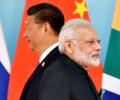
Prime Minister Narendra Modi on Tuesday met Chinese President Xi Jinping in Fortaleza, Brazil and pressed for a solution to the boundary question, saying if the two sides could amicably resolve the vexed issue, it would set an example for the world on peaceful conflict resolution.

A total of over 75 Heads of State and Foreign Ministers will be meeting with Modi, external affairs minister S Jaishankar and minister of state for external affairs V Muraleedharan during the week across various platforms.

India and China met and spoke a lot this year, but failed to produce any meaningful results.

After two decades, the SCO appears to be at a cross-roads with the US withdrawal from Afghanistan, asserts Srikanth Kondapalli, the leading China expert.

Amid imminent phasing out of the fiscal stimulus by US Federal Reserve, Prime Minister Manmohan Singh on Wednesday called for an "orderly exit" from unconventional monetary policies being pursued by the developed world for the last few years to avoid damaging growth prospects of the developing world.

India and China on Monday admitted to intrusion by Chinese herdsmen into Ladakh last week but both the sides sought to play it down saying the issue was resolved amicably through a flag meeting.

Modi, who will be addressing the General Debate for the first time in five years, has a packed bilateral and multilateral agenda beginning September 23 till September 27.

India and South Africa on Friday agreed to deepen engagement in key areas of defence production, manufacturing, mining and minerals and combating terrorism.

With Beijing having had a profound rethink on India's admission as a full member of the Shanghai Cooperation Organisation, the tectonic plates of the geopolitics of a massive swathe of the planet stretching from the Asia-Pacific to West Asia are dramatically shifting. That grating noise in the Central Asian steppes will be heard far and wide -- as far as North America, says Ambassador M K Bhadrakumar.

'This novel format of diplomacy -- the informal summit -- will not only facilitate bilateral communication and reduce miscalculations at the very top level of the two governments, but possibly open the space for China and India to speak in one voice on various issues of mutual concern,' note Feng Renjie and Ding Kun Lei
Indian Non-Governmental Organisations are very dissatisfied with the weak response of Environment Minister Jayanthi Natarajan to the Rio+20 declaration issued on the eve of the summit, reports Darryl D'Monte.

Colombo seems to be veering to the middle path between China and the US on global matters, but in regional matters of strategic security, it is increasingly identifying with India, points out N Sathiya Moorthy.

Official sources said the two leaders will meet for around four to six hours for the 'agendaless' talks

'The Chinese can't be trusted hence the need to verify and re-verify.'

The comments came a day after sources said China maintained a sizeable presence of troops near the site of the Doklam standoff with India and had started widening a road, around 12 km from the area of conflict.
'With Pakistan's 'first use doctrine' threatening the use of nuclear weapons early in a war with India, the S-400 will shield vulnerable targets like Delhi and Mumbai, complicating Pakistan's targeting calculations.'

Addressing the BRICS investment seminar in Mumbai ahead of the 5-nation Summit in Goa on October 15-16, Jaitley said the government has put FDI on automatic route in almost 90 per cent of the areas that are eligible for foreign direct capital.

'New Delhi showed itself willing -- at least for a period -- to tolerate the risk of conflict and to withstand Beijing's implicit and explicit threats.' 'But it also continued to try to cut some kind of deal with China to reduce tensions.'

The finance minister is in Singapore for The Singapore Summit.
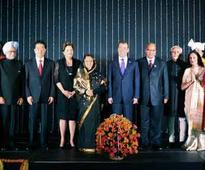
As advanced economies continue to be consumed by the tailback of the economic crisis that struck in 2008, the germ of an alternative model of economic growth seemed to be emerging on the anvil of the BRICS regional grouping that held its fourth summit in Delhi here on Thursday.

He just finished his first foreign visit as prime minister and now PM Narendra Modi has has been invited to witness the final of the World Cup football currently being held in Brazil.

The G20 meeting of the finance ministers and central bank governors beginning July 19 will also be attended by Reserve Bank of India Governor D Subbarao and Deputy Governor Urjit Patel.
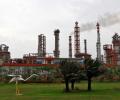
The agreement came in after the Ruias agreed to clear most of the Rs 26,000-crore dues to the lenders on completion of the transaction.
Investment announcement for $100 bn over 5 years likely.

'There is gradual rise in the number of nations viewing Pakistan as the nursery of global terror.'

After participating in the BRICS-BIMSTEC Outreach Summit in Goa, Myanmarese leader Daw Aung San Suu Kyi arrived in Delhi for an official three-day trip to India.
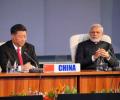
'Modi's finest political legacy ought to be a border settlement with Beijing,' asserts Ambassador M K Bhadrakumar.

It's a packed 5-nation, 9-day, visit for Prime Minister Modi as he heads to Uzbekistan, Kazakhstan, Kyrgyzstan, Turkmenistan and Tajikistan, apart from Ufa in Russia.

Despite criticism of a lack of transparency and communication from the Modi-led government, BJP leaders point to "good beginnings" on several fronts to defend its performance. Sheela Bhatt/Rediff.com reports.

But Modi and Xi will attend a BRICS leaders meeting in Hamburg.

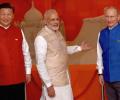
In a series of tweets -- in Russian and then in English -- on the eve of his visit to Russia, Modi said he looked forward to his meeting with Putin.

The Chinese Communist Party's all important 19th Party Congress is just months away, and President Xi Jinping finds himself confronting unlikely challenges to his pre-eminent position, says former RA&W officer and China watcher Jayadeva Ranade.

The prime minister's comments come close on heels of the developed countries threatening to cut vital aid to the developing nations if they do not back the deal agreed at the UN climate summit in Copenhagen.
Prime Minister Manmohan Singh arrived in Brazil on Thursday on a two-day visit during which he will attend the Brazil-Russia-India-China (BRIC) and India-Brazil-South Africa (IBSA) Summits and hold bilateral meetings with Chinese President Hu Jintao and Russian President Dmitry Medvedev.
